2023
Research group Philosophy and Professional Practice
Research, Ideation, Prototyping, Testing,
User Experience Design
UX/UI Designer, Junior Researcher
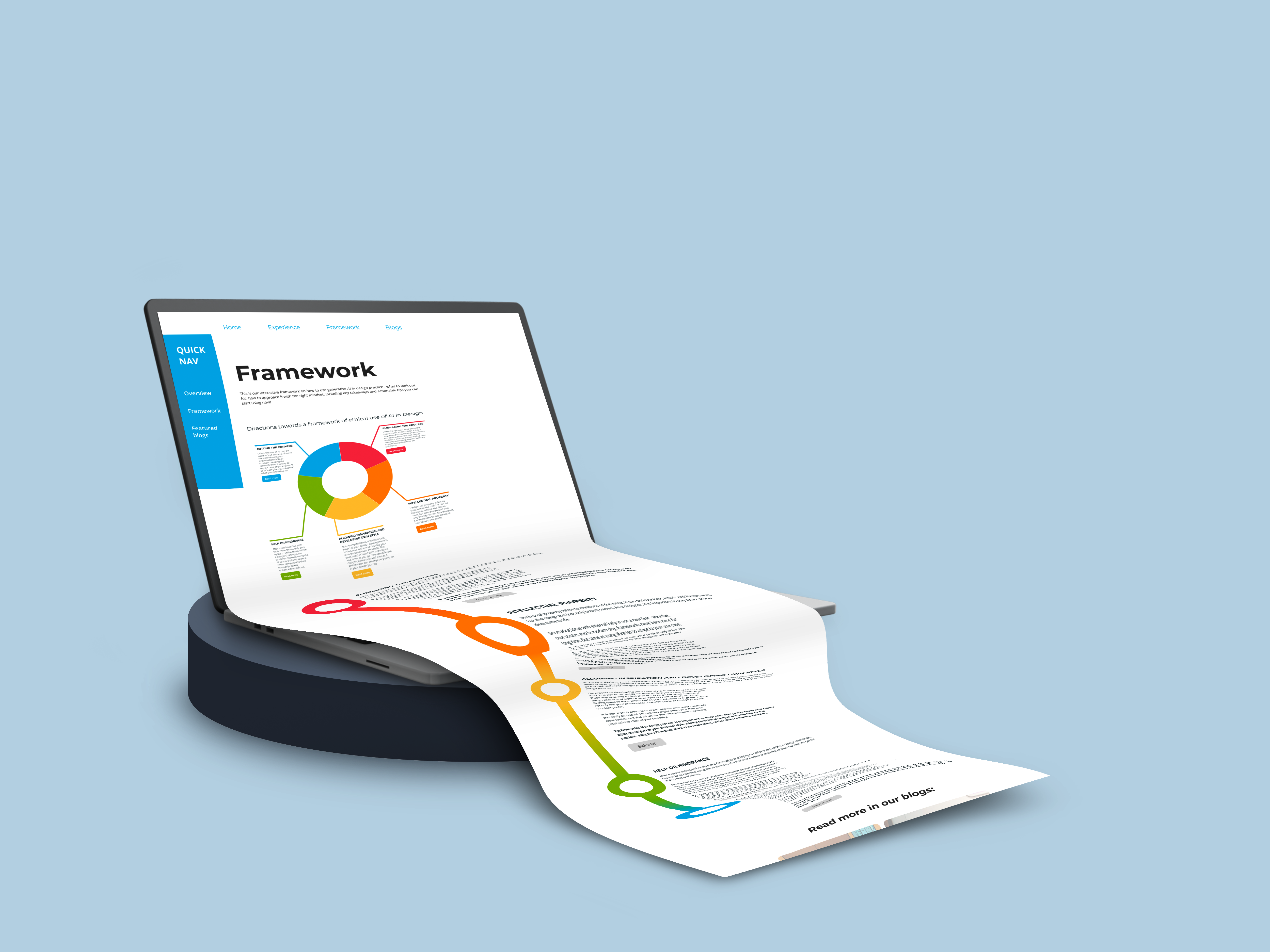
The main challenge of this project was to investigate the impact of generative AI on design field and communicate the important findings to (not only) young designers and professionals, helping them bridge the shift in industry and adapt to new, emerging tools.
With the emergence of AI tools, it’s impact on design is bigger than ever. We have to ensure that us, designers, stay on top of the change, and do so in a ethical, fair-use compliant way.
User Research
Academic Research
Ideation
Prototyping
Testing
User Experience Design
At the start of the project, it was very important to set a focus point to direct the process. Though I initially had multiple direction proposals for the client, one stood out as particularly interesting.
After discussing with my client, we decided to investigate the interplay of Generative AI, Anthropomorphism in Design and Ethical use of these tools, and design a product to inspire young designers and help them with this shift in the industry created by AI tools. This got synthesised by one research question:
What are the ethical considerations for using generative AI in design, such as the potential for biased or unfair results, and how can these be addressed?
Answering this question would lay a foundation on what topics need to be addresed through the design in the next phase.
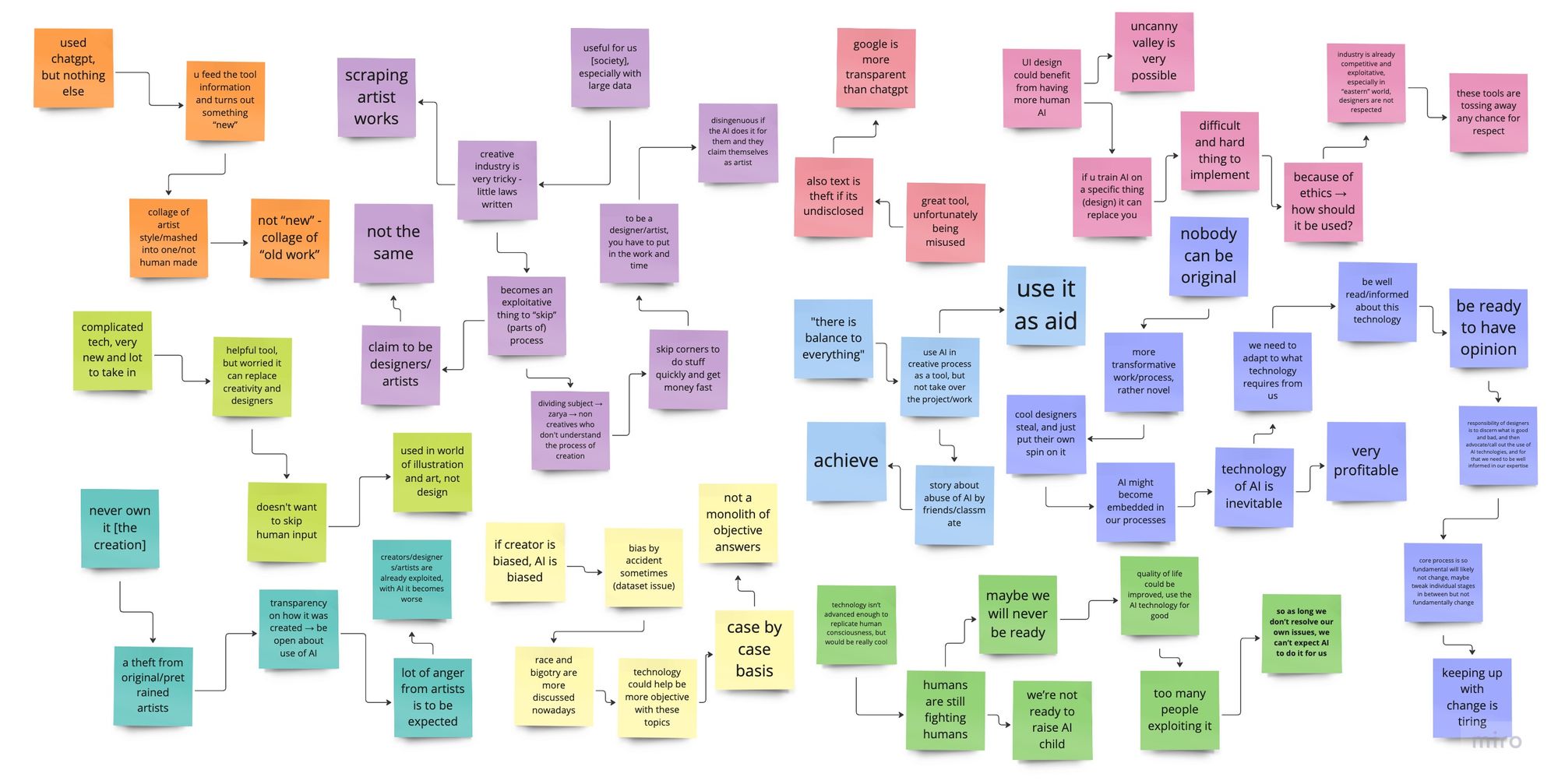
A node-based interview analysis with quotes and thoughts
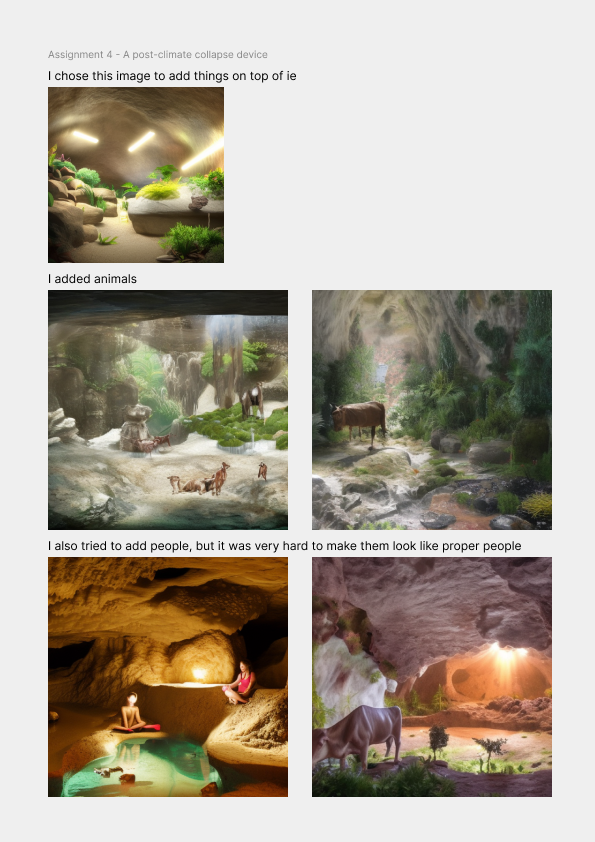
An example of the design fiction assignment result by one of the participants
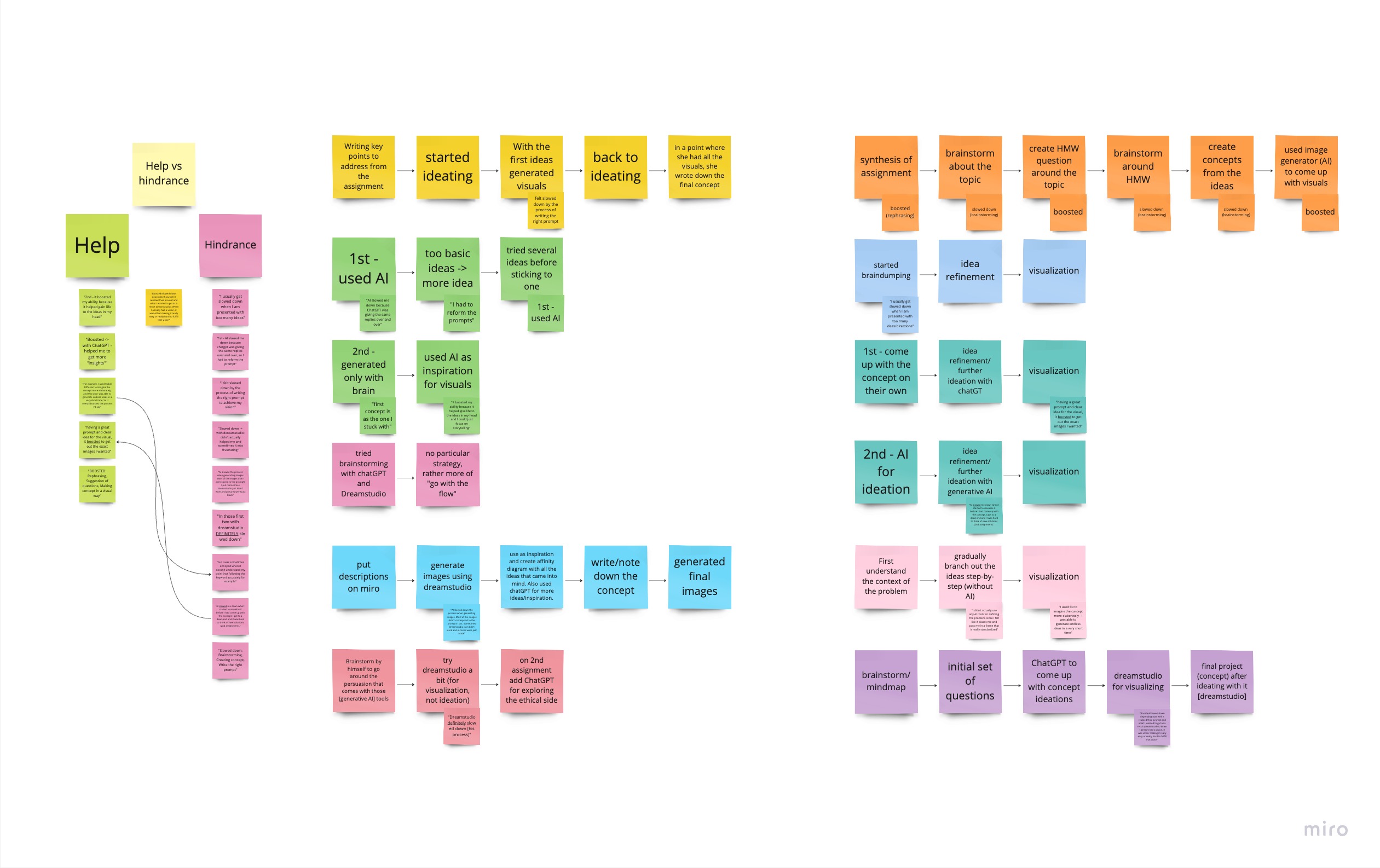
Post-design fiction survey analysis
The setup of the research was crucial, as I needed to get a good understanding on how young designers approach, think and interact with generative AI tools. Besides literature review, I also decided to conduct my own ethnographic research.
I decided to first conduct a series of unstructured interviews, in which a free-flow conversation allowed the participants to dive deep into anything they'd like. This allowed me to grasp the initial patterns of interaction, as well as gain understanding into mental models of how designers think about AI.
A follow-up method to this would be a series of Design Fiction assignment. This method was chosen to further see how exactly the interactions with AI work within an actual design challenge setting. The participants had series of vague, yet challenging tasks during which they had to utilise AI tools and push the boundaries of their skills, as well as the limits of AI.
At the end of the design fiction assignments, the participants presented their results (as they couldn't see each others work beforehand, to avoid influencing them), and filled out a short survey to further note down their views, workflows and thought processes.
After the initial interviews, it became clear that my original focus - the interplay of Generative AI, Anthropomorphism in Design and Ethical use of these tools was too broad.
I decided to stop focusing on anthropomorphism in design - something initial research review showed was that the use of human traits is rather for skeuomorphic - trying to replicate "real world" (in this case the human-like conversation) for the sake of easier interaction for users, rather than being genuinely "human".
This allowed to further distill the research and analyse thoroughly the data into insights
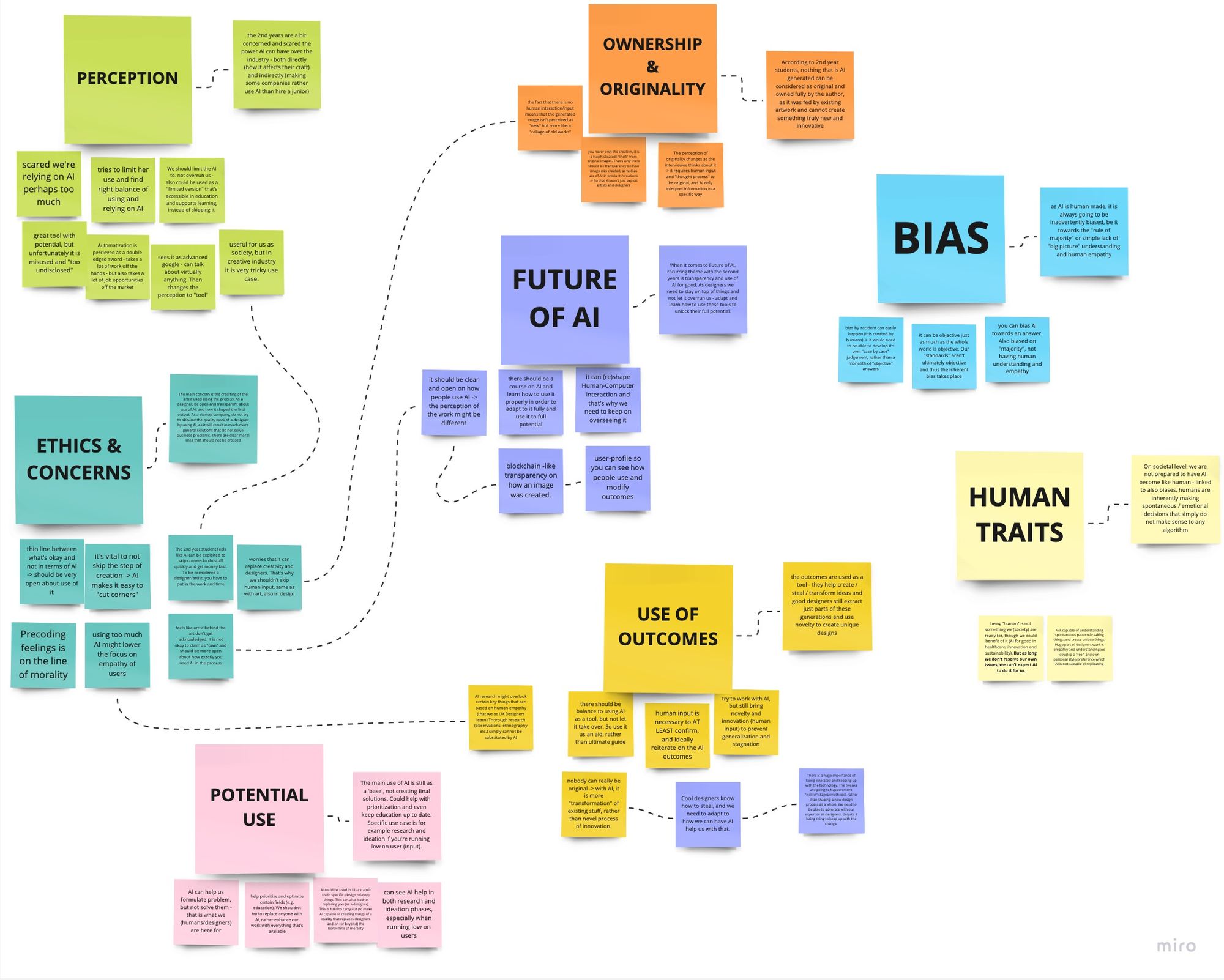
Connected quotes and thoughts from individual interviews into patterns and insights
After the conducting the research, I analysed the data and came up with a list of insights, which I then used to fuel further steps. I analysed each interview into a node-based system of thoughts and quotes. After that, I started recognising underlying patterns between different stages of "maturity" of the participants - commonalities and differences between 1st, 2nd and 3rd year design students, as well as working junior designers.
Here are some of the insights:
- Most users have very little knowledge about AI and how to work with the tools.
- Associated with the little knowledge, there is big "respect" or "fear" of the tools - some fear of being replaced by AI.
- A prominent use case for generative AI is inspiration and formulation of ideas - acting as a "springboard" for their creativity.
- It is easy to overlook ethical side of using AI tools, and what can happen when users of these tools aren't aware of hidden biases in the AI generations.
All of these insights were then put into a cohesive Design Vision, which you can see below.
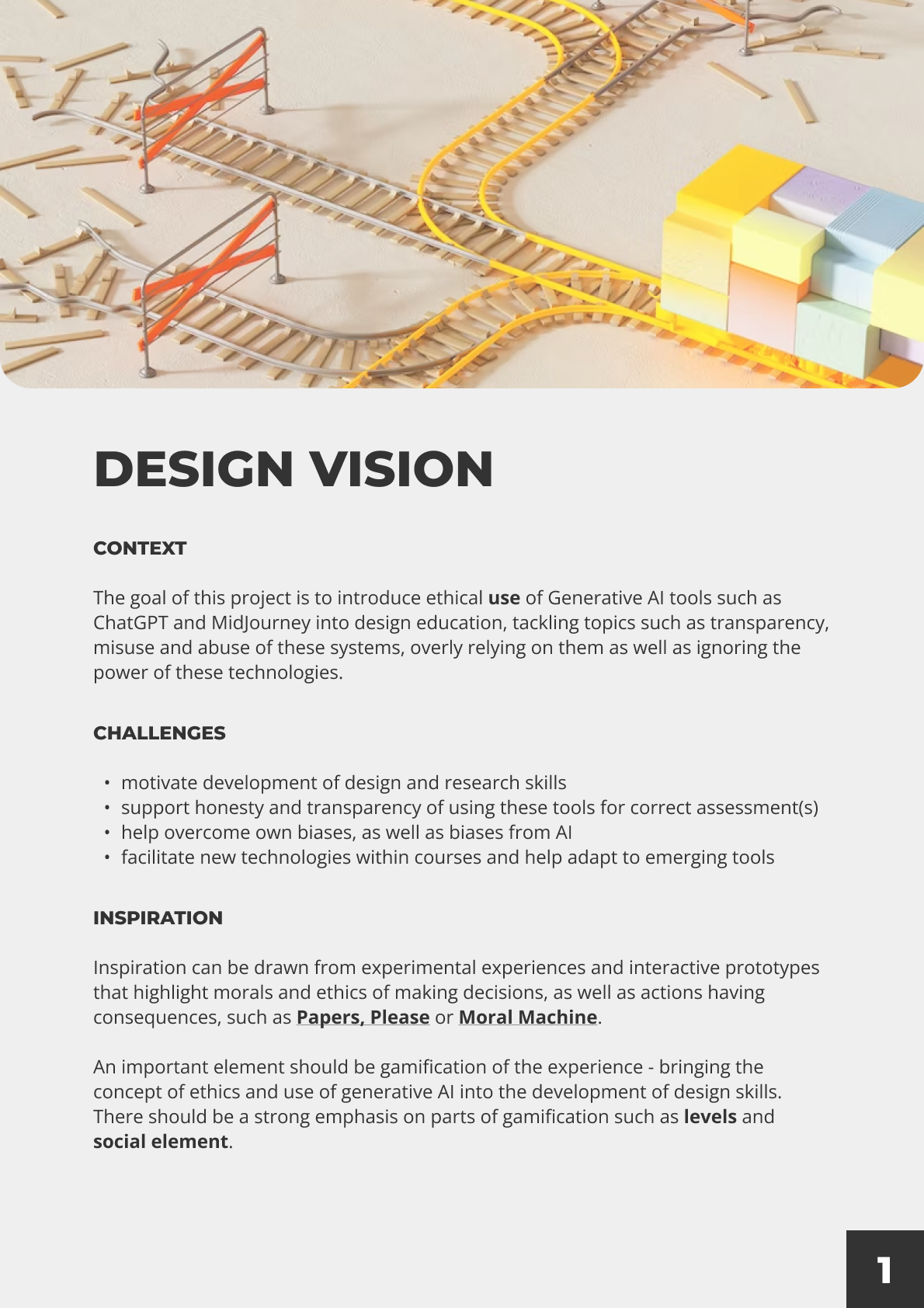
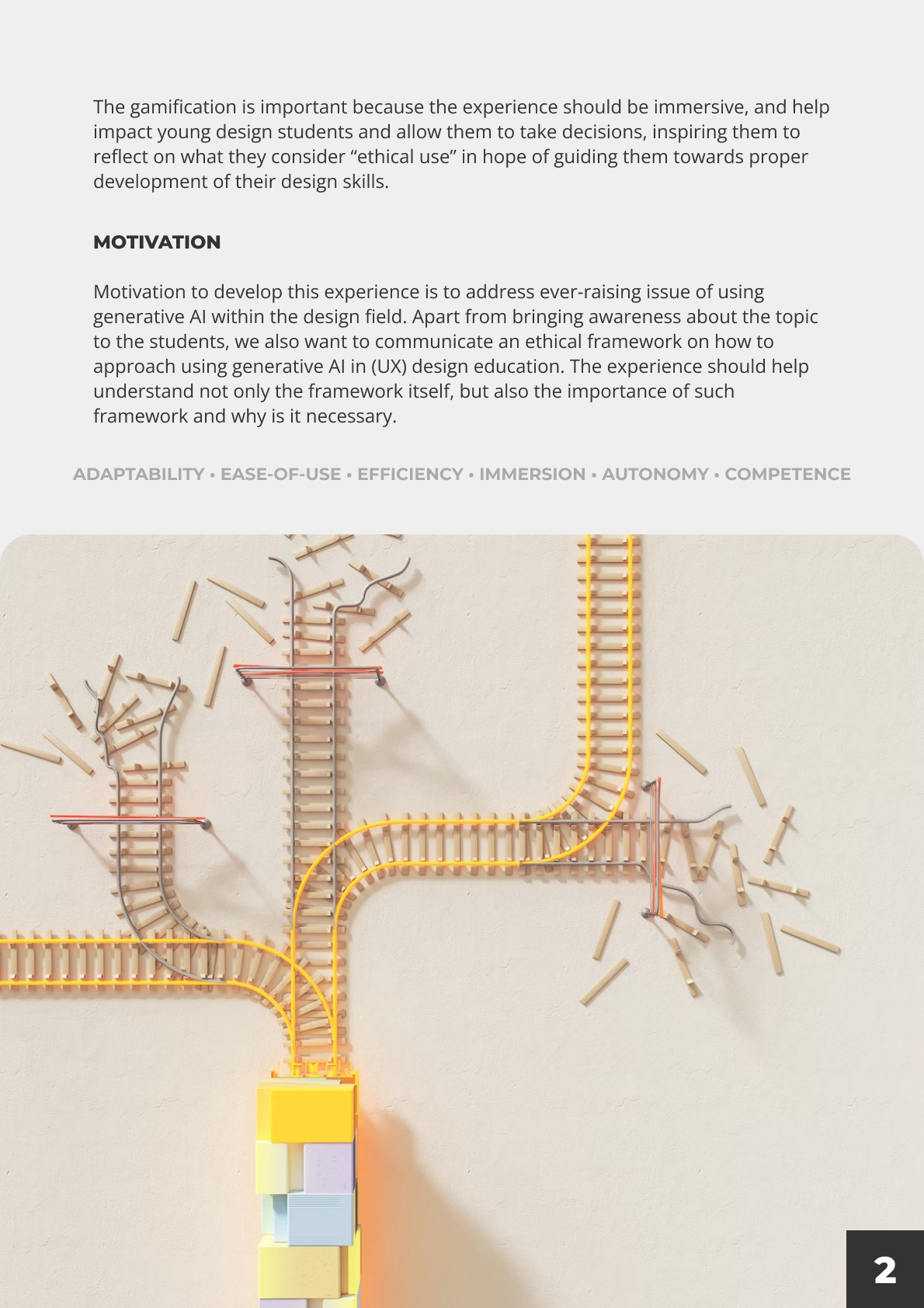
My main concept direction was an ethical framework for using generative AI in design practice. Connected to this concept is an interactive gamified experience that activates them to reflect on their use, and prompts them to ethical use within their design career. Since the solution should be impactful and prompt reflection to the users, I believe that using an immersive experience where the users are the ones making decisions is a good way to achieve that.
The research has shown that there is a need to create a product that allows designers to learn the ins-and-outs of the AI world, as well as reflect on their use and motivate ethical use of the tools. In the ideation, I wanted to create a meaningful solution through brainstorming and creative sessions with the target group.
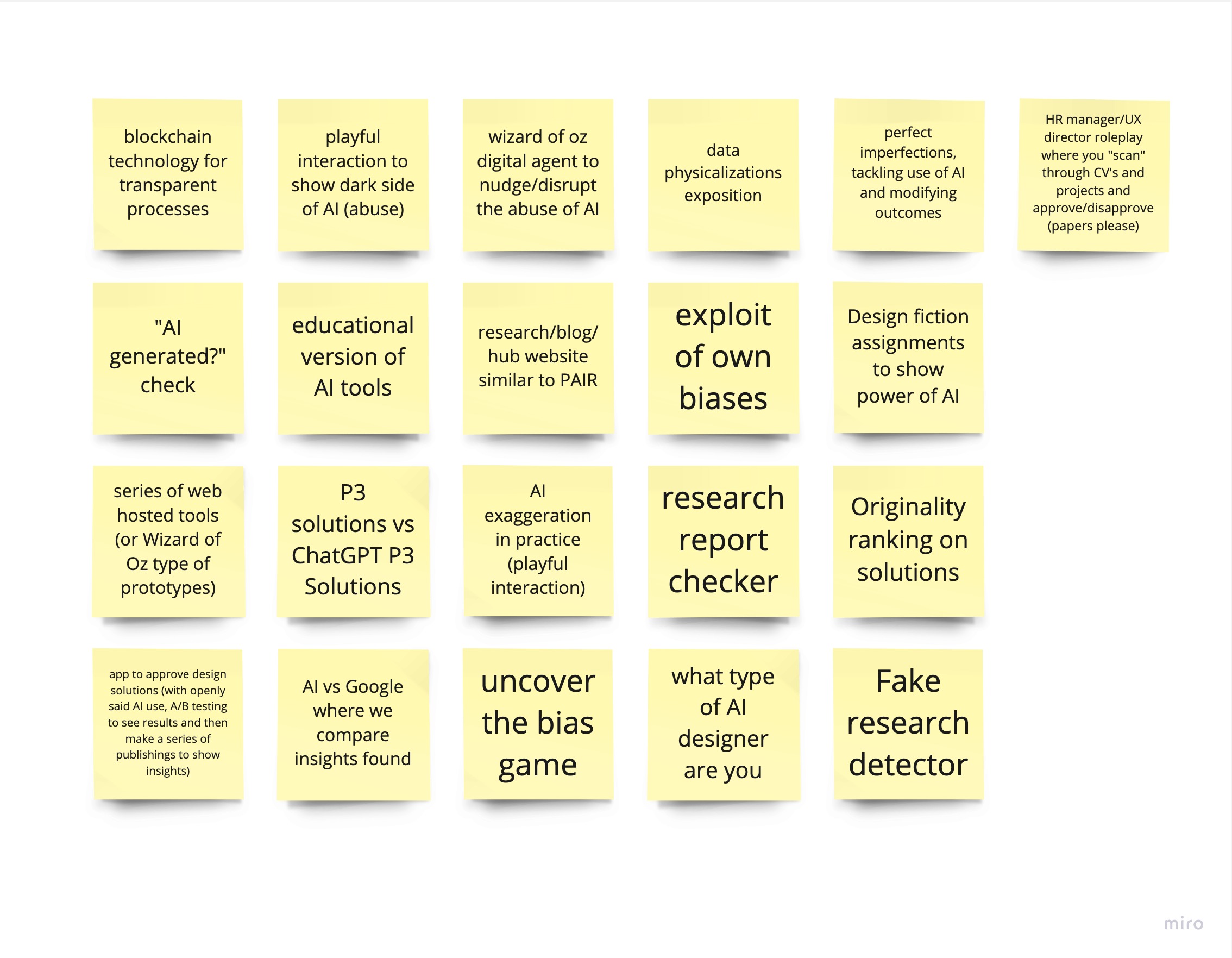
Initial braindump
The first thing to do in ideation was to purge myself of initial ideas. I brainstormed very quickly about possible solutions and ideas that could solve the main task - informing and engaging users into the world of (ethical) AI.
On the left, you can see the result of the first brainstorm, in which I created in total 21 apps. I noticed that
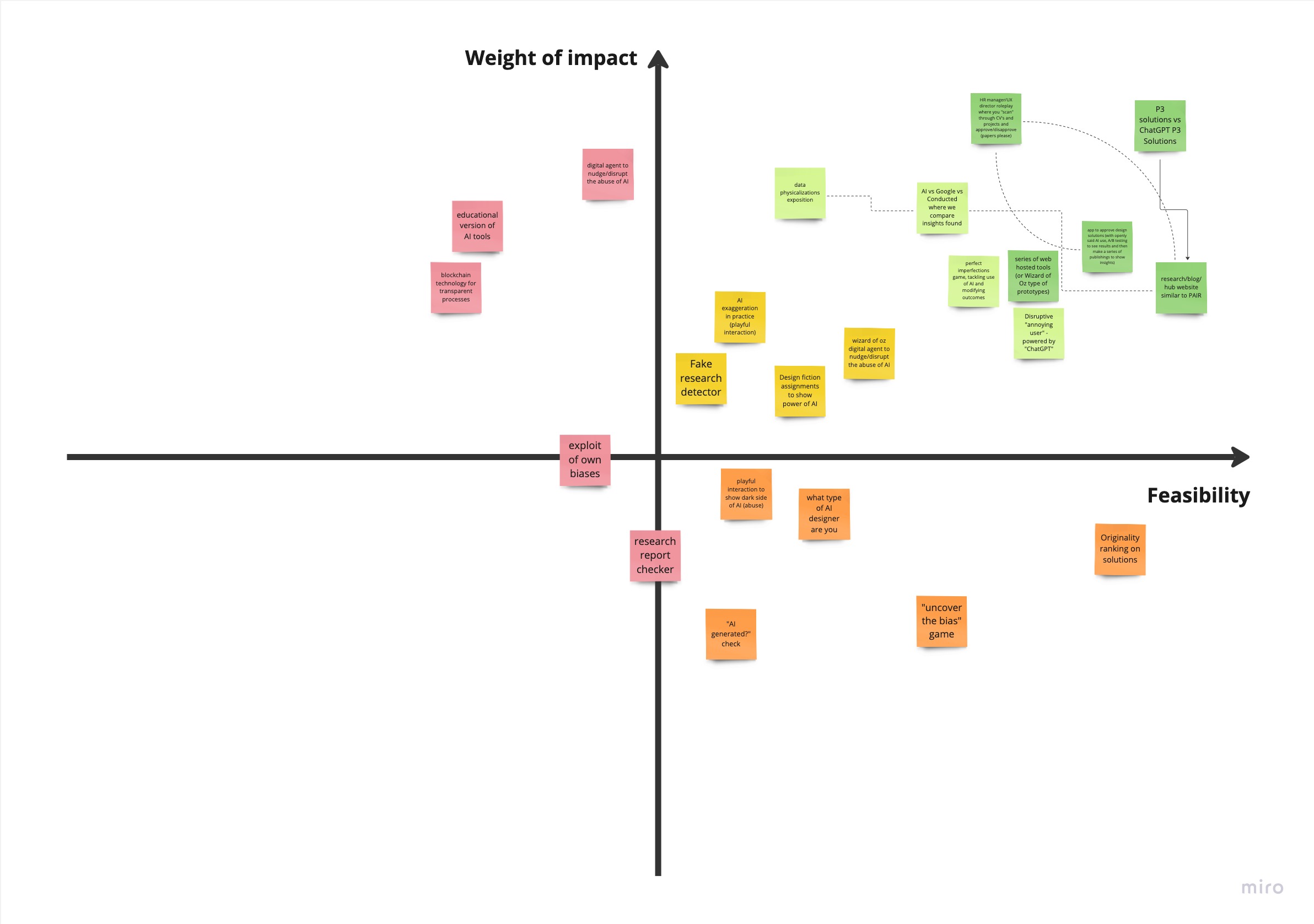
Colour coded initial ideas from braindump on a Weighted matrix
After the brainstorm, I wanted to understand which of the ideas can be connected and form more complex solutions. To do this, I have decided to "weigh" the ideas on matrix, which you can see on the left.
The X axis of the matrix represented a Feasibility to develop at least a "proof of concept" level of prototype until the end of the set timeframe (roughly 1 month). The value was measured by technologies and tools required to carry out necessary level of detail in the prototype.
The Y axis represented the possible Weight of Impact that the solution would have on the users. This was measured by how much interaction, decision making and conclusions can be drawn from the solution.
Once weighed, I started marking ideas by colours, and linking the potential combinations between ideas to form complex solution.
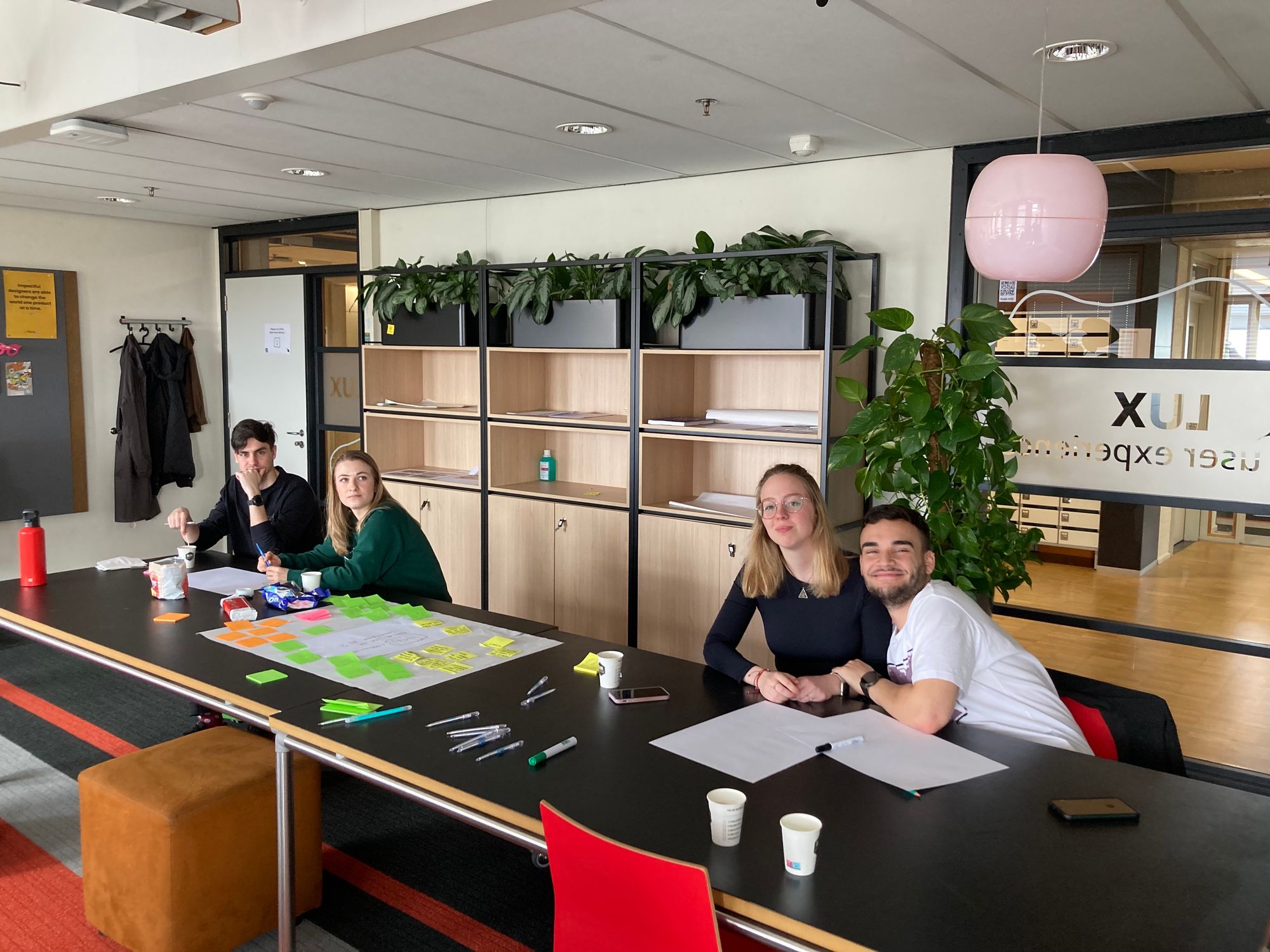
Co-creative session - design charette duos working on ideas
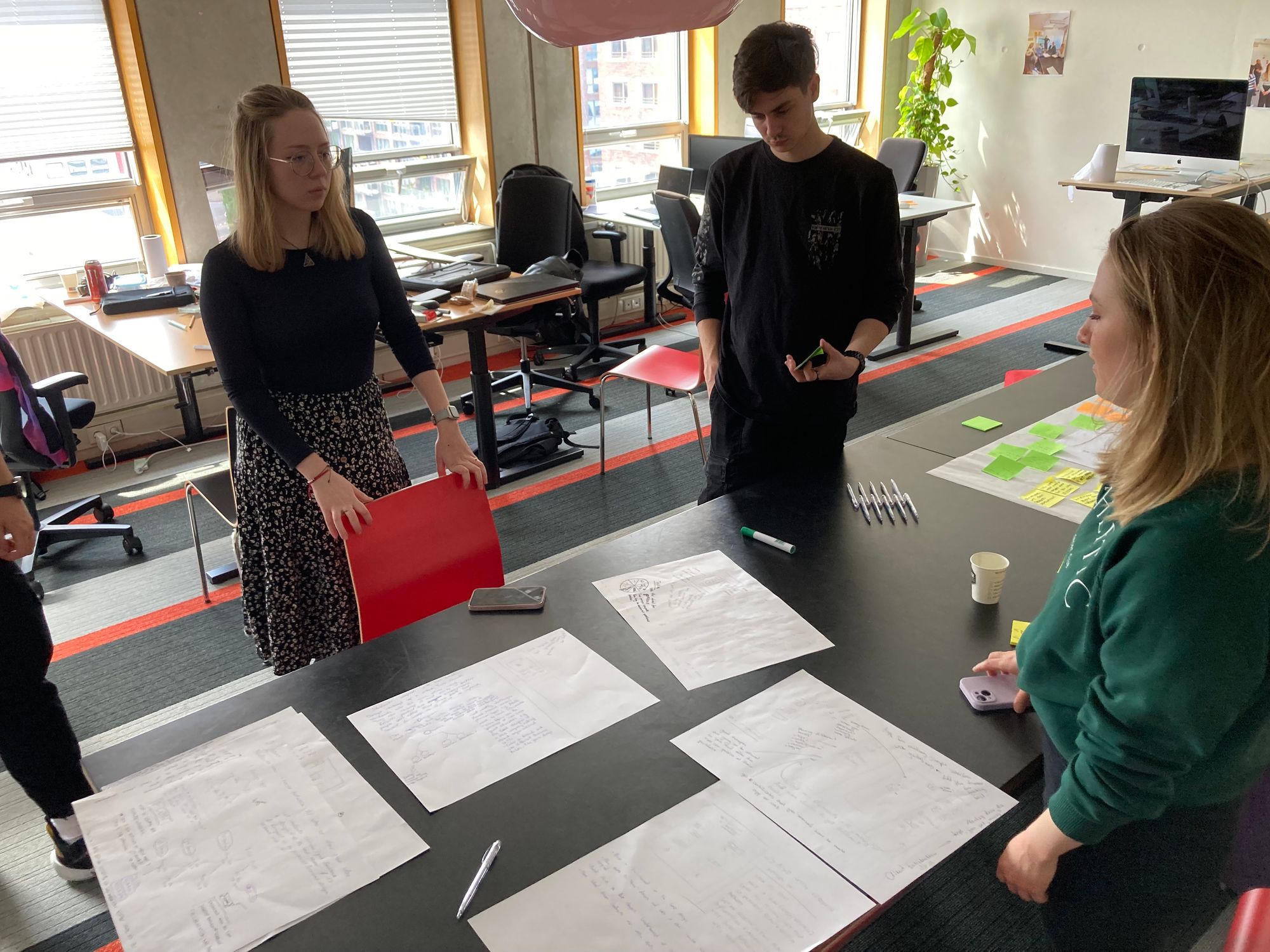
Co-creative session - evaluation of ideas
Having a general idea of what the final solution should be - informative, playful, and with emphasis on ethical use of the AI tools, I set out to further generate, now more specific ideas together with the target users. For this, I created a creative session, during which different techniques were used.
At the start, I would introduce the co-creative session participants to the topic and the main issue - talking about the impact Generative AI has on design practices, and why ethical use is important in this topic.
This was followed up by a short brainstorm to rid ourselves of first ideas. For this brainstorm, I created a question to help generate ideas: HMW communicate an ethical use of gen. AI?
After initial brainstorm, we moved on to our main creative technique - Design Charette. During this technique, the participants were divided into pairs, and silently working on their ideas in short time periods - every 5 minutes, one of the participants from each duo would change their seat, bringing fresh view and ideas from other duo.
In total, this technique would go in two rounds for each of the following HMW questions:
- HMW make an impactful experience prompting students to reflect on use of generative AI?
- HMW use gamification to help development of design skills?
After long idea generation, my plan was to converge with the target group through triading - a method in which three options are presented, and one has to go -> ultimately leading to a "top 3" of ideas.
However, due to time constraints of the session and availability of the participants, we had to cut down on that, as we were already past the planned timeframe. That's why I quickly decided to go in a round with the participants, each stating what they like the most about all the generated ideas.
Since the project was aimed at young & potential Designers - a demographic I was myself part of and had good access to - I wanted to ensure project is well tested before deployment and potential developments further.
Using the outcomes from my creative sessions as a baseline, as well as the converging of the session, it was clear that a gamified experience would leave a more lasting impact than just regular text posts. However, my client, being academically oriented, wanted to ensure that there is also space for more knowledge-sharing from their side.
I've come up with a solution to combine the two concepts into a new platform, making use of knowledge sharing blogs for the client, interactive Framework to work with AI in design (education) and a gamified, reflective experience to provoke a thought and critical thinking from users.
As I was running very steadily towards the end of project, I have decided to adapt R.I.T.E. method, aiming to go through 3 cycles of: Design -> Test -> Reflect -> Redesign to quickly increase fidelity and quality of the prototype based on feedback from users.
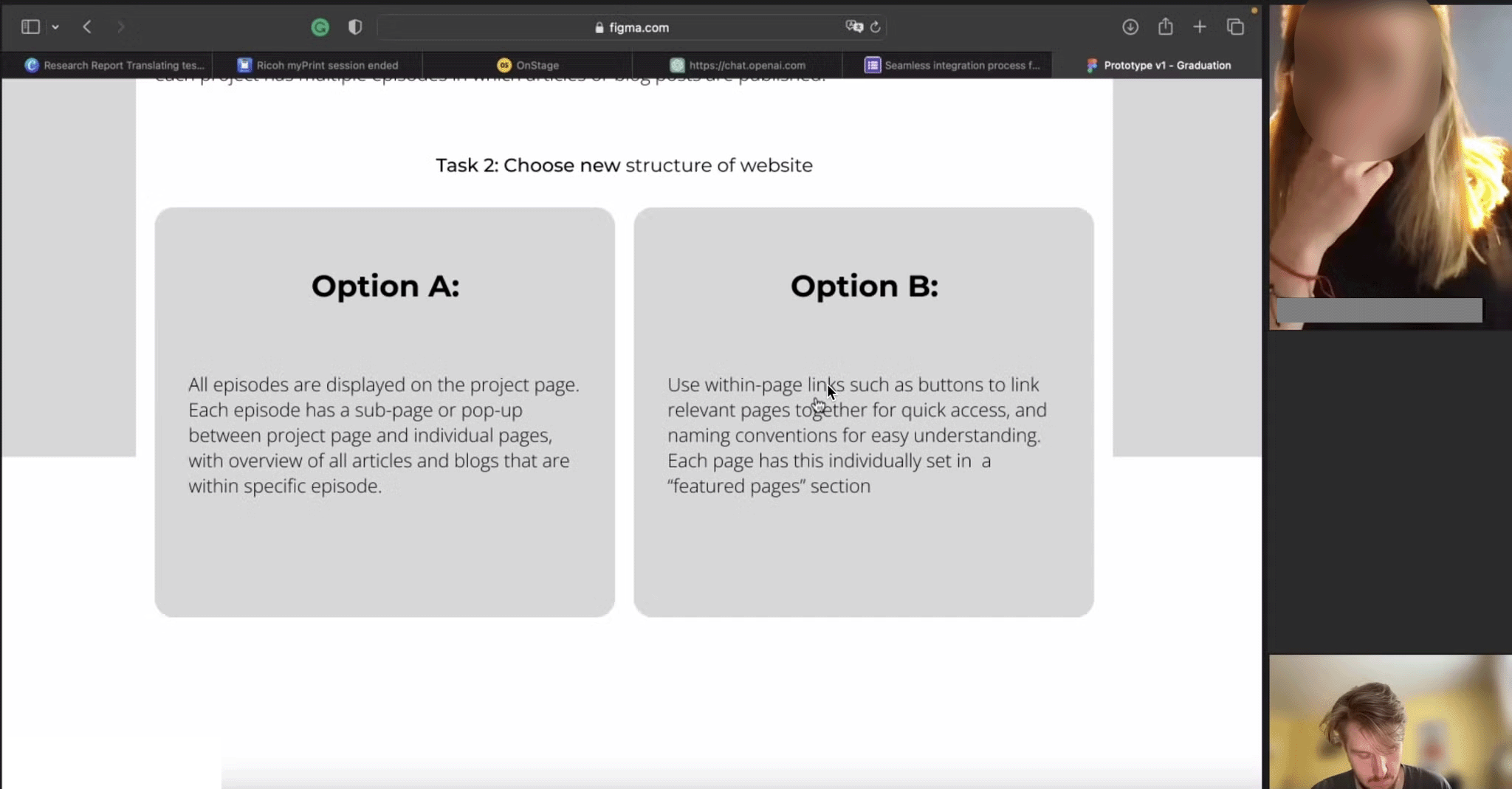
User trailing number 1 - text-heavy tasks causing accessibility issues
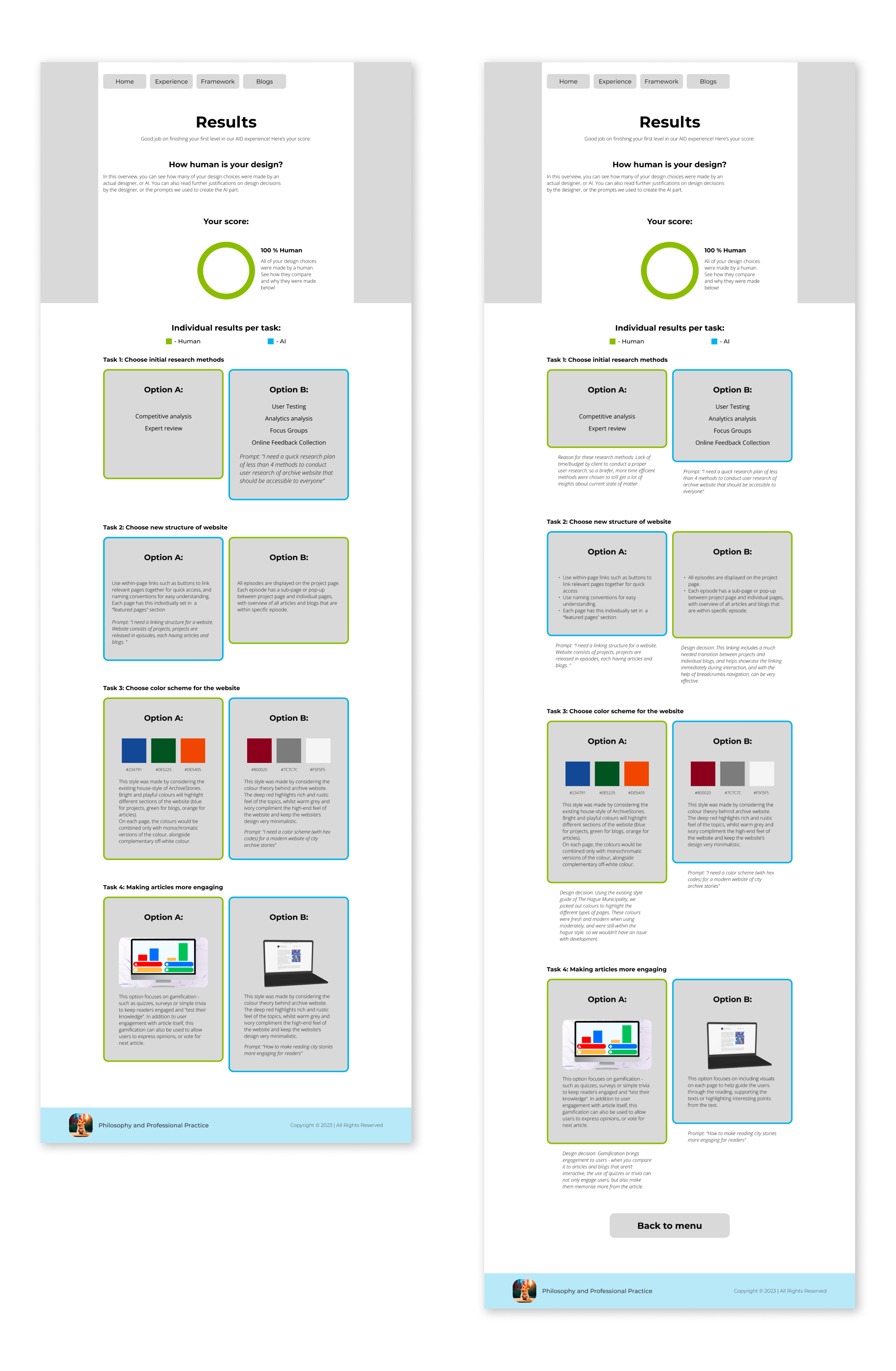
A side-by-side comparison of initial version and v2 with changes based on user input
After initial design phase, I had a rough wireframe and system architecture to test out. Though it was not polished design, I wanted to ensure that the testing is still valid, so certain parts of the prototype, e.g. the gamified experience or the framework of approaching AI were given a bit more polish than other parts.
Main goal of the testing was to recognize biggest pain-points and potential stops in the experience. Besides that, I wanted to also learn more about the user retention of information. Every test went with the same protocol:
1. Explore the website quickly for 1 minute
2. Navigate to the “game/experience” on the website and go over the first level. Once they were done with the level and ended up on the results page, we quickly discussed how the experience was, whether they understood the point of it and mainly, if it was fun.
3. Go over the framework in 1 minute, and click on the blog page afterwards (we are going to test what you remember from this page)
4. Explore the rest of the page at your pace, and let us know your general thoughts and whether you feel like something is missing or not
The test results were very positive in conceptual side - the information retention was very good from the interactive framework. However, it also highlighted a few points of improvement in the prototype. For example, there was a missing feature - despite the short time of the experience, users forgot their selected choices.
This lead to a new feature in the next iterations -remembering choices of users and highlighting them in the summary screen. Another crucial finding was about accessibility of the gamified experience - since the tasks were full of text, users with visual impairments or dyslexia might have troubles reading the text. That lead to the change of the text structure into bullet-points.
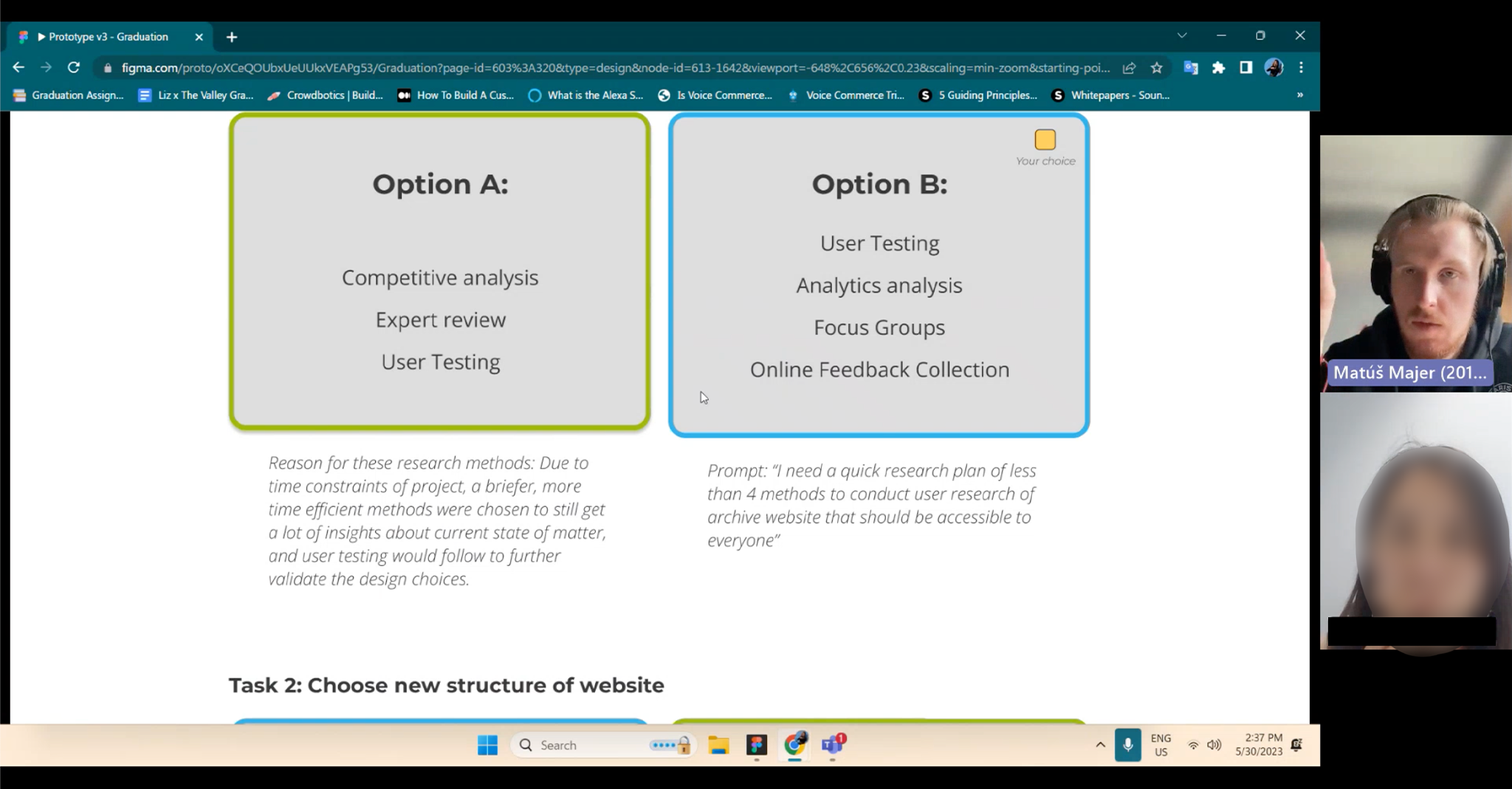
Updated summary page with explained design decisions and visual representation of user choices
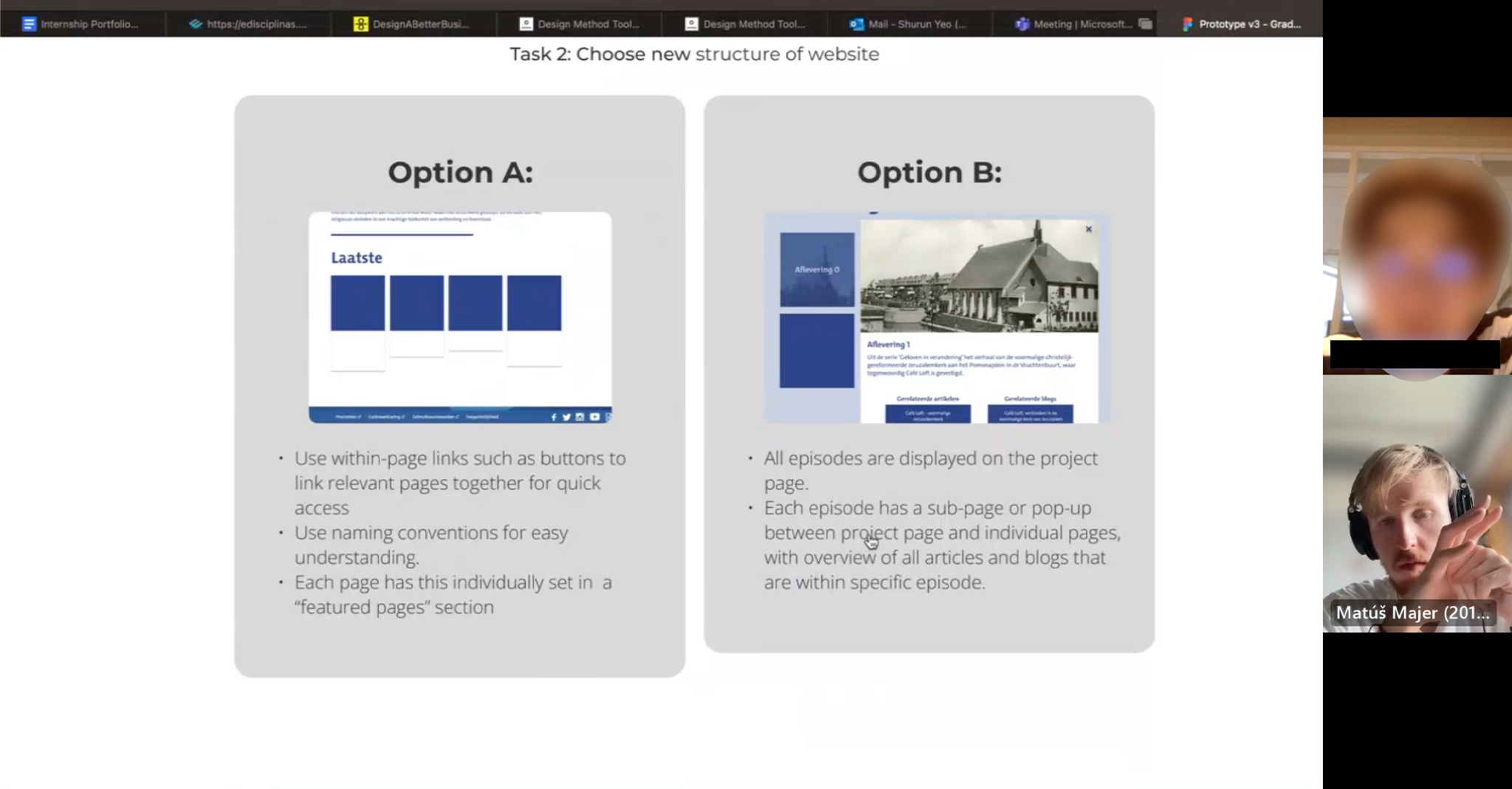
Last round of testing - added visuals for tasks
In further iterations, the same test protocol as before followed, with only slight changes - for example, in the final round of testing, users had only 40 seconds to browse through the framework. The design got polished and expanded through multiple rounds of tests. In total, I conducted 6 user tests with total of 4 design iterations.
Over time, I've taken the user feedback from each round and implemented new features and refined overall fidelity. I've scrapped the idea of sidebar navigations from earlier versions, added further visuals to help imagine the choices before selecting them, and gave components a visual overhaul to improve the fidelity. The summary page received a reworked structure also with outcomes, design explanations and overall easier takeaway/reflection section
The final design came to life by recognising a gap in the "market" - there was no platform that would unify the information from the world of AI in a digestible way for designers, with actionable hints and insights they can apply in their current and future projects immediately in the form of a interactive framework.
Another important part of the final prototype was the reflective gamified experience, building on one of the ideas from the co-creative session. In this experience, the users would be presented with a real design assignment/problem, and two solutions - one made by a human designer, one generated by AI. At the end, they would receive the results of "How human their design is" and an overview of individual answers, to see and compare different solutions.
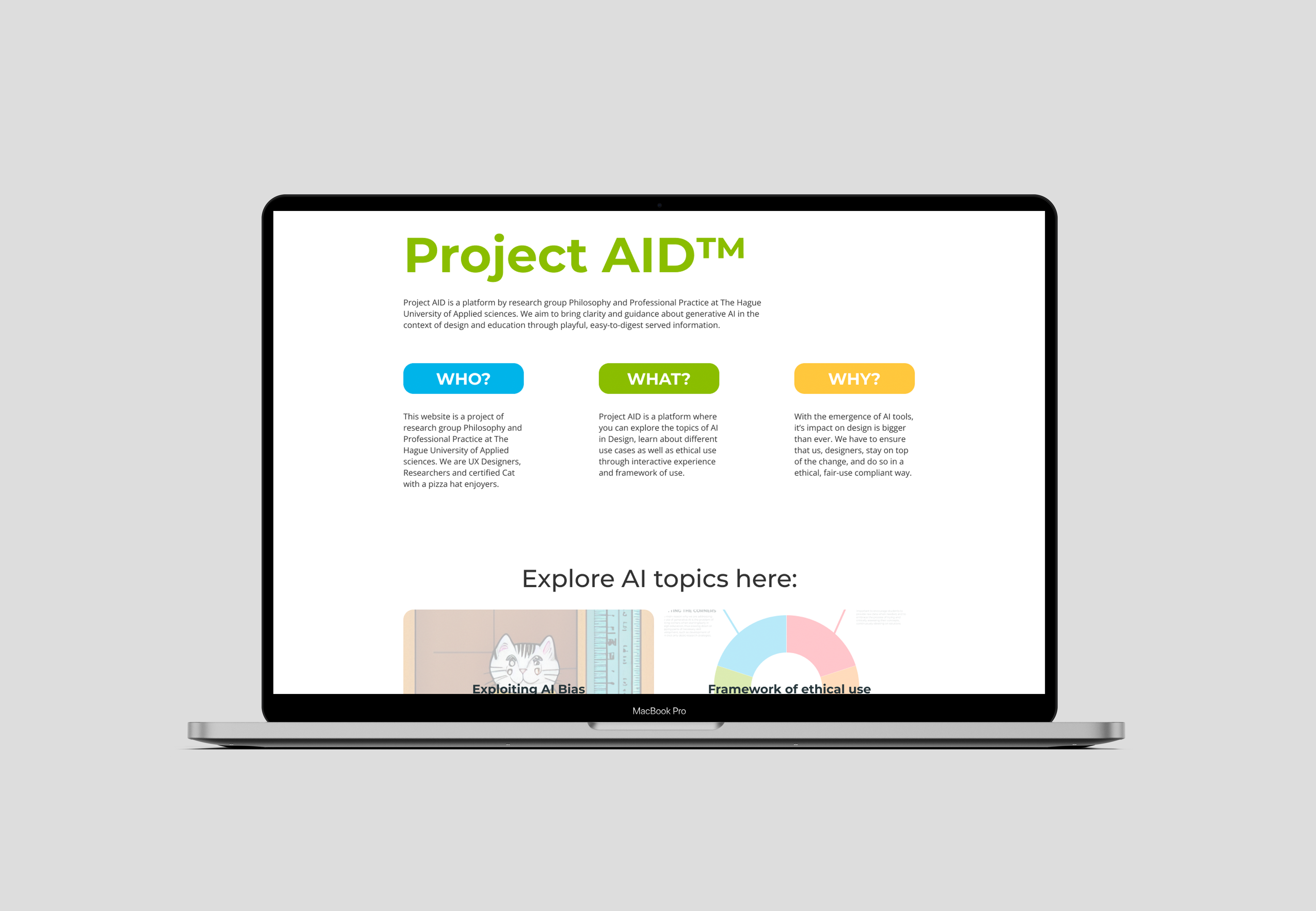
Landing page, presenting users Who what and why of the project, as well as prompting exploration of the content.
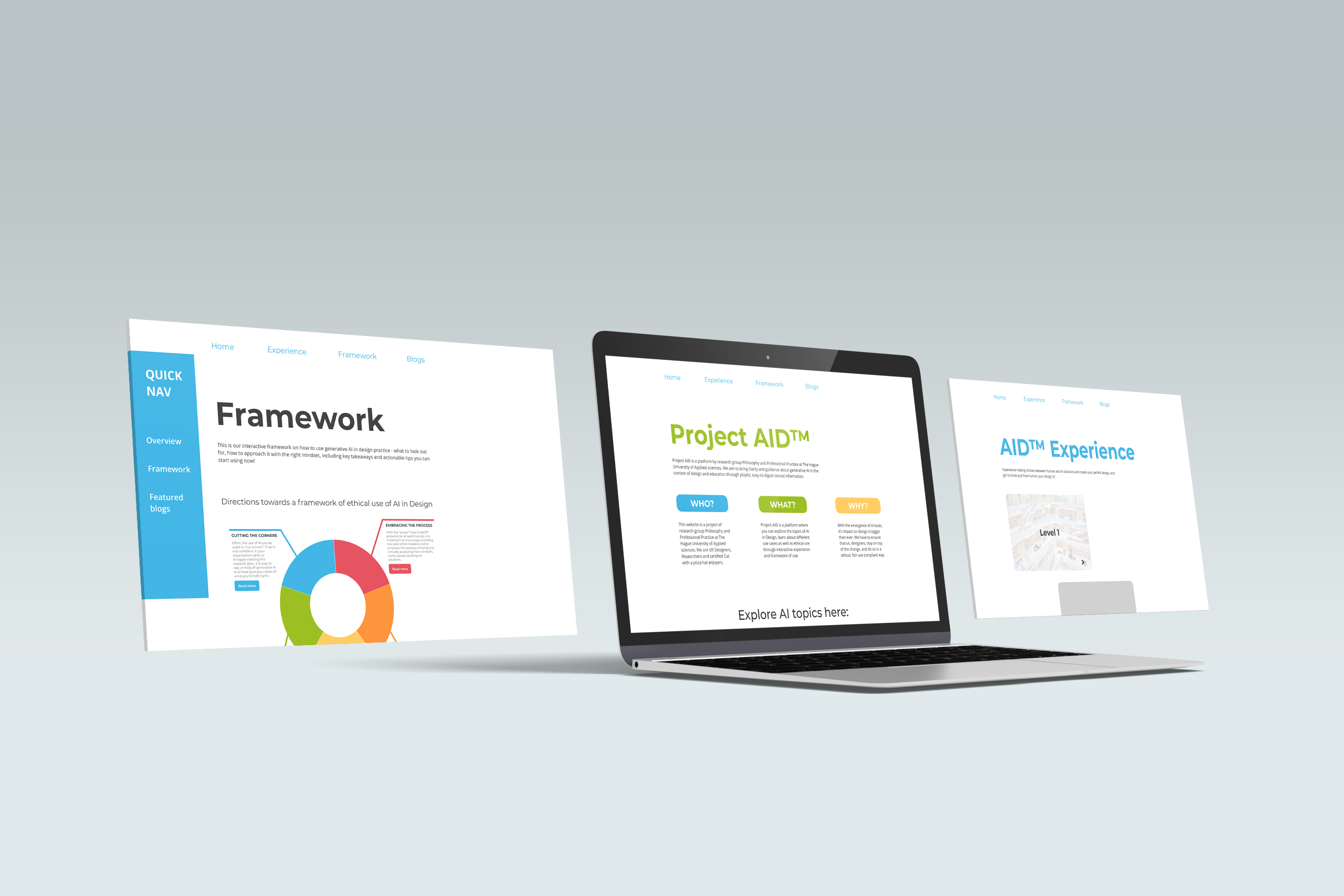
The platform consists of three main pages - Landing page, exploring the different parts of AI; Interactive Framework, to learn about and discover key tips of using AI in design; and immersive gamified experience, in which users make decisions to see "how human/robotic" their solutions were.
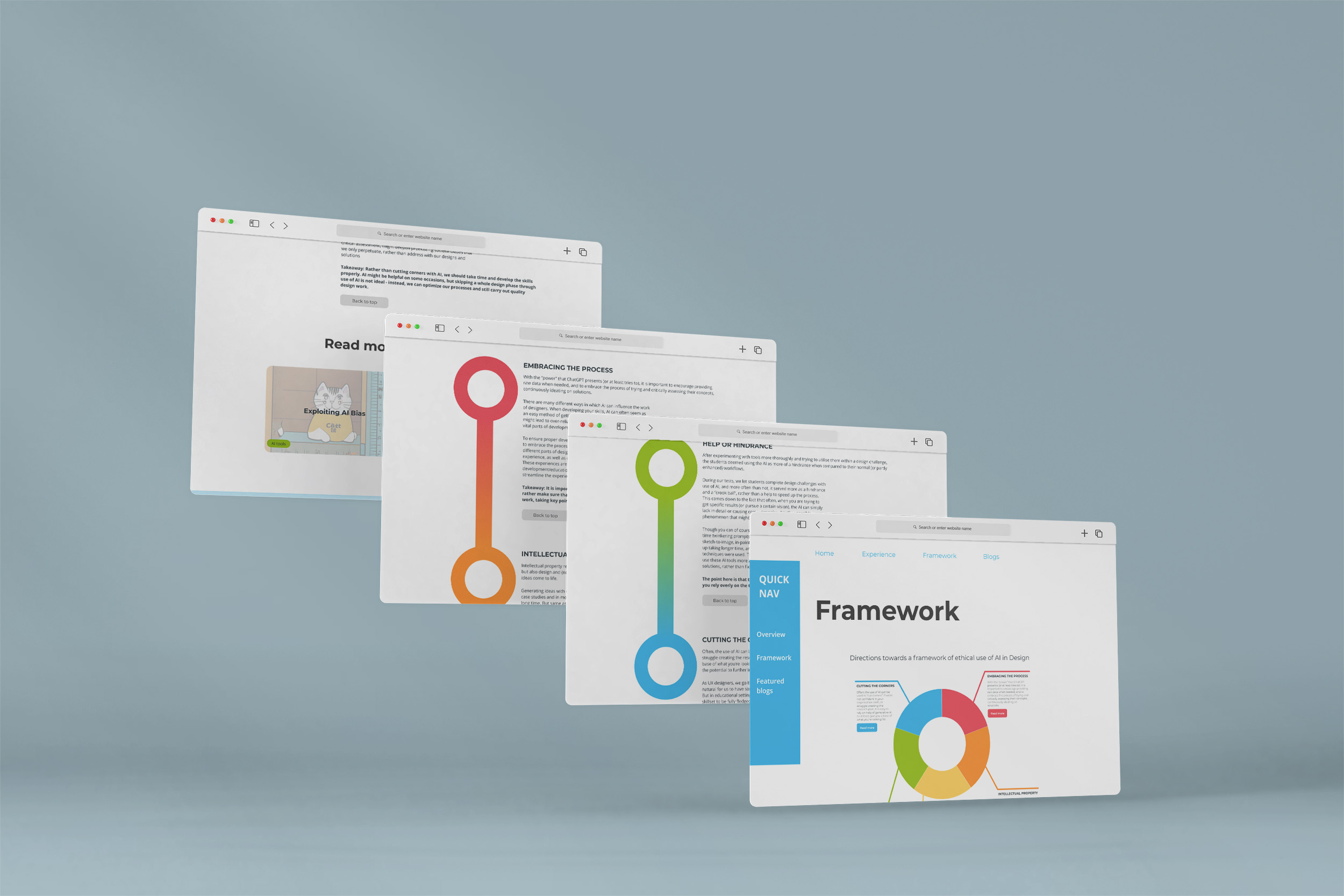
Interactive framework - showcasing different aspects of ethical use of generative AI tools in design practice
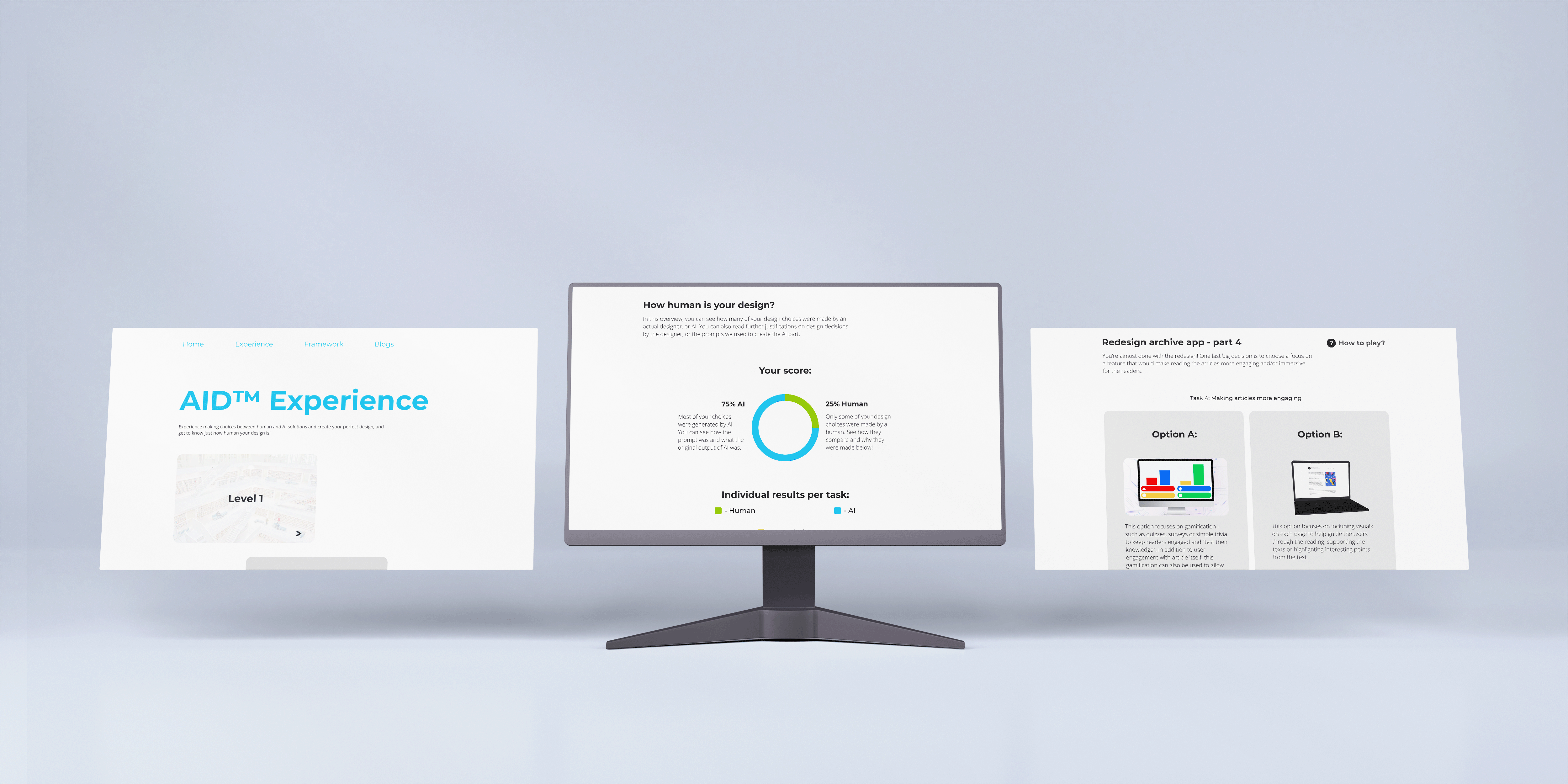
Flow of the experience is streamlined -> pick a level (problem), go through tasks and make decisions, and see your results!
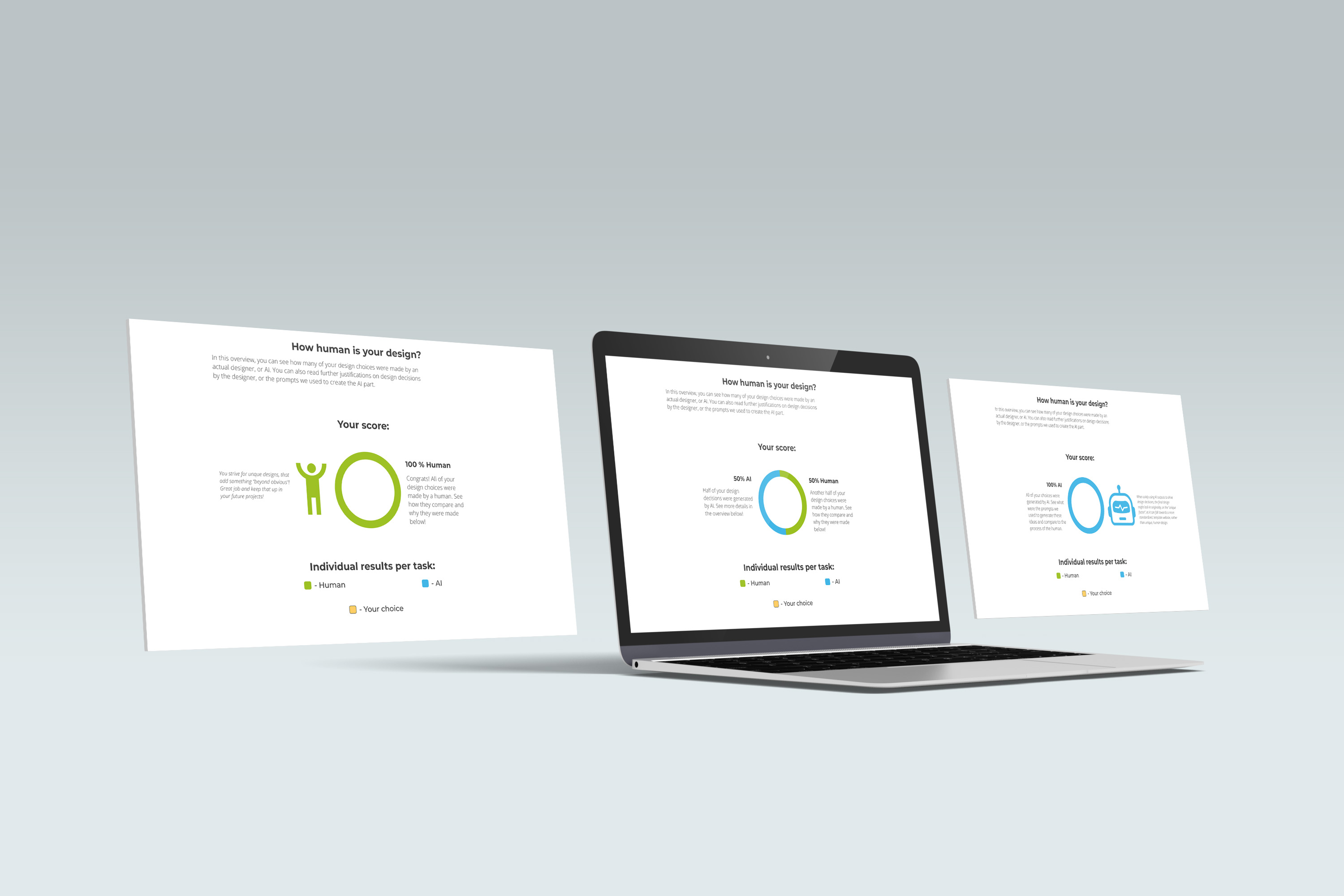
Flow of the experience is streamlined -> pick a level (problem), go through tasks and make decisions, and see your results!